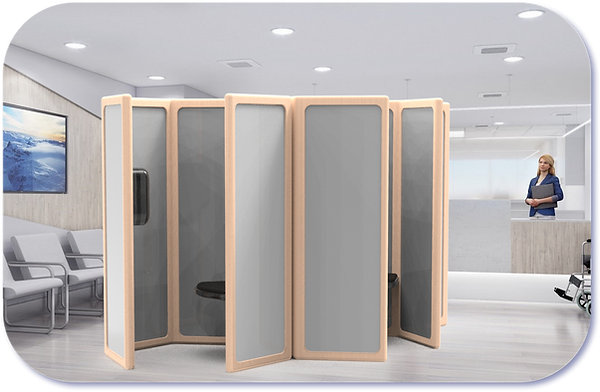
The check-in pod is an innovative way to provide a private, comfortable check-in experience to new patients aged 18-22, specifically ones transitioning from the pediatrician to the physician. The goal of the Dr. Pod check in experience is to comfort the patient while helping them better understand their personal healthcare.
Project Guidelines
This project was sponsored by:

Group Members:
Caroline Hammond and Taylor Hicks
Objectives: To answer the question: How can we use technology to enhance the patient check-in experience at the doctor?
Duration: Started 08/23/22, completed on 12/14/22
Skills: Conducting interviews, journey mapping, persona creation, user testing, prototyping, story telling, Figma, Autodesk Fusion 360, Keyshot

Target Audience:
18-22 year olds
Why we chose to focus on this user group:
1. Pediatrician to Physician Transition: Transition from a family centered to patient centered practice approach presented problem areas
2. Most Common Type of Appointment: More available data was able to researched
3. Most Relatable Demographic: We're able to provide more empathy for users, and there was more available user research at Georgia Tech

Interview with Medical Professionals
Our group interviewed three pediatric healthcare professionals, all serving different roles in the check-in process. The main takeaways were as follows:
-
Distractions such as entertainment or medical forms seem to make the waiting process go by faster for patients.
-
Being able to see where the patient is in the check-in process saves the doctor a lot of time.
-
When patients are late to their visit, it creates a domino effect, messing up the doctor’s whole day.
-
Online EMR and MyChart software helps with behind the scenes documentation and patient communication.
-
Older pediatric patients often don’t fully understand their insurance policy.
Overall, the behind the scenes check-in process seems to be streamlined.
This is not so true for the patient.
Interview with Pediatric Patients
Our group interviewed four patients that had recently been to the pediatrician or physician. The main takeaways from these four include:
-
Many patients agree that it would be easier if the check in was online (filling out forms, etc).
-
Patients prefer in person visits rather than tele-health visits because they are able to create an emotional connection with the doctor and have more trust.
-
Most patients get a reminder text or email about their appointment. This shows that pediatric offices value staying on schedule and being organized.
-
Many pediatricians still use traditional check in methods; using a clipboard and sheets of paper. Patients expressed that this can take a long time.
-
Many adult doctors use MyChart, which is an easy way for the patient to access their healthcare information and history as well as prescriptions.

Patient's Underlying Needs

Quick Treatment
-
Less paperwork
-
Shorter wait times

Independence
-
Ability to schedule and attend appointment alone
-
Understanding their own health (health literacy)

Comfort
-
Feeling prepared for an appointment with proper documentation
-
Acceptance by medical staff and others in the waiting room

Guidance
-
Help throughout the check-in process
-
Transitioning from the pediatrician to physician

Health Literacy
-
Knowledge about personal and family health history
-
Understanding health insurance plans

Stability
-
Economic security
-
Safety and health
Key Takeaways from Research
An online process is preferred by patients and doctors
Most students aged 18-22 still visit their pediatrician, despite being an adult, due to convenience and comfortability.
There is a unique reliance on parents or guardians, which creates separate opportunities for different types of patients who do not visit the doctor with a parent.
This leads to our problem statement:
How can we improve the check in experience at primary care offices for patients ages 18-22?
Design Goals
Schedule matching with doctors when creating appointments
Comply with HIPAA regulations
Eliminate stress around canceling appointments
Decrease anxiety within patients when communicating personal history with doctor
Find efficiency in the waiting room
Make a welcoming atmosphere in the waiting room
Discover a more efficient way to fill out forms
Find an effortless way to communicate between patients and doctors outside of appointments
Increase health literacy in young adults
Make a simple interface that is understood by all ages
Promote independence in young adults to prepare them for a physician
Create a more efficient way to use tele-health technology
Ideation

Key Ideas


After creating 300 thumbnail sketches, we separated them into 12 groups, each with a different design parameter.


Narrowing Down to Three Concepts


Chosen Concept: The Pod

Our final concept combines the physical space of the pod with a patient-centered app.

App Interface
Created in Figma


Pod Screen
Interface
Created in Figma


The Pod